How to choose a crop spraying drone in 2026
Updated 11 October 2026
The right spray drone is the one that keeps up with your spray window. Start from the hectares you must cover in a day, then work back to tank size, battery count and charging power.
1. Hectares per day decide the class
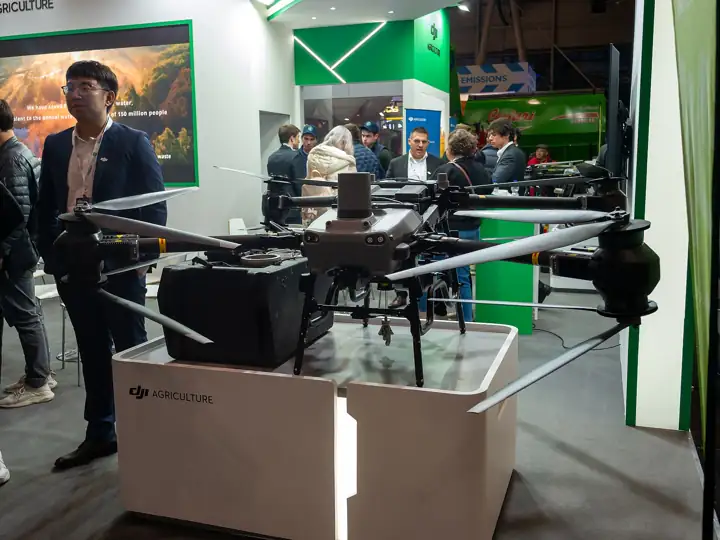
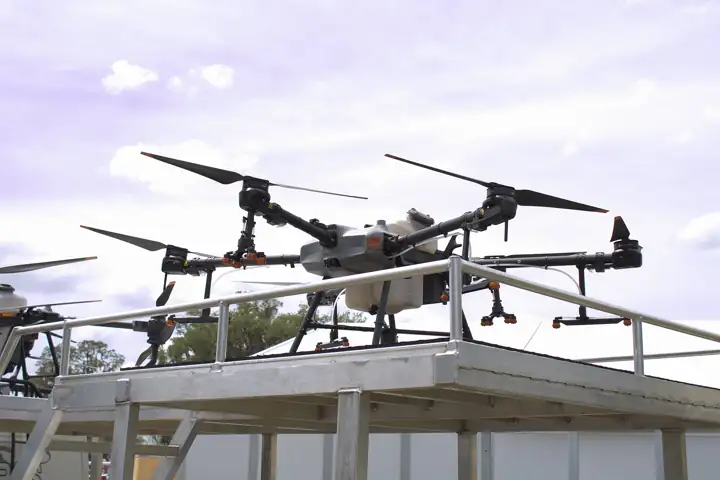
As a rule of thumb at 10 to 15 L/ha: a 20 L drone such as the Agras T25 covers roughly 8 to 12 ha per hour in open fields; a 40 L class drone (Agras T50, XAG P100 Pro) 15 to 21 ha per hour; the 100 L Agras T100 is built for contractors covering well over 300 ha a day. Orchards and vineyards run slower because of higher volumes and turns.
2. Terrain and obstacles
For slopes, terraces and orchards, sensing matters more than tank size. Phased array radar (DJI), LiDAR (T100) and binocular vision (EAVision) let the drone follow the canopy. Twin rotor designs such as the XAG V40 push spray deep into dense canopies.
3. Batteries and charging are part of the machine
Plan two to three flight batteries per drone and a charger that refills one battery in the time a flight takes, for example the C10000 power supply with DB1560 batteries for the T50. Budget a generator for remote fields.
4. Spreading, seeding and lifting
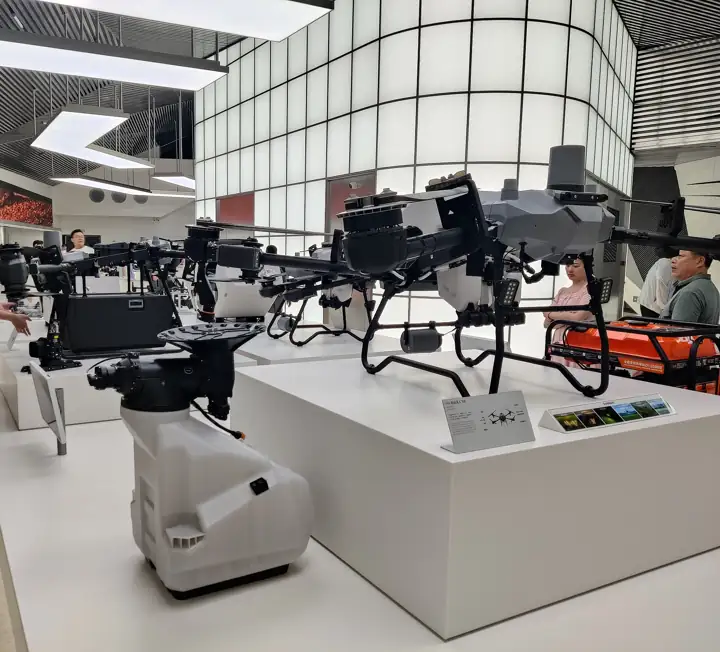
Most current drones swap the spray tank for a spreading tank for granular fertiliser, seed or bait. If spreading is your main use, check the spreading tank volume and the discharge rate.
5. Licences before you buy
In the EU, spraying plant protection products from the air is banned unless your country grants a derogation. Read our regulations overview before ordering, and make sure you can obtain the operator authorisation for a drone of this weight.
Shop the range
 DJIDJI Agras T50
Coaxial twin rotor spray and spread drone with a 40 L spray tank, 50 kg spreading payload, phased array radar and binocular vision.
Price on request- DJIDJI Agras T25
Compact, foldable one person spray drone with a 20 L tank and 25 kg spreading payload.
Price on request - DJIDJI Agras T100
DJI's flagship: 100 L spray tank, 150 L spreading tank and 85 kg lifting for the largest operations.
Price on request